
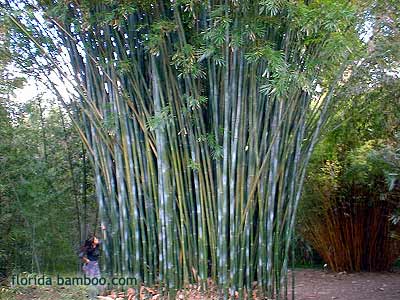

Bamboo is probably the most underutilized category of landscaping plants in Florida. The exotic tropical feel and elegance strike a deep emotional chord with many people. In gardens with big, mature specimens, it is common to hear people’s voices drop to hushed, reverential tones as they come into view of the bamboo stands.
Large types, with canes the diameter of soup cans, have an air of primeval strength. Smaller varieties, with their fountains of cascading foliage, have an air of elfin delicacy about them. All are especially captivating on a windy day – watching masses of bamboo foliage dance in the wind is a sight of extraordinary beauty.
Runners versus clumpers
We’ve all heard the horror stories: “Don’t plant bamboo – that stuff will take over your whole neighborhood!” Bamboos have a reputation for invasiveness, and that reputation is based on a truth: some kinds do spread aggressively. What’s less well known is that there is a whole category of bamboos that do not spread aggressively and do not represent a threat to the neighborhood.
The two basic categories that most bamboos fall into, depending on their growth habits, are runners and clumpers. Running bamboos have long, cord-like underground stems called rhizomes, which travel long distances underground and pop up new shoots out of the ground many feet from the parent canes, forming a grove of widely spaced canes.
Clumping bamboos, on the other hand, have very short, stout rhizomes that send up new canes just inches away from the existing canes, forming a tight, compact clump, which makes these ideal plants for landscaping.


Many of the running types can be quite aggressive spreaders, expanding their bamboo patch by as much as twenty or even thirty feet a year if conditions are to their liking. Then there’s the human factor: the widely spaced canes of running bamboos are easy even for someone not very skilled at working with plants to dig and transplant, so running bamboos have been the ones over the years that have been most widely planted in Florida. This has, unfortunately, given many people the mistaken belief that all bamboo spreads like wildfire. This common belief, and the lack of knowledge and availability of clumping types, have kept the outstanding clumping bamboos from being more widely grown and appreciated.

Clumping bamboos have a number of characteristics that suit them to human needs as landscape plants, beyond just their lack of invasiveness. The tight growing habit of the clumpers make them an outstanding visual screen and sound barrier, enabling urban and suburban residents to surround their small city lot with a wall of green foliage, giving them the privacy of country life while living in the city. Few people can fail to be moved by the powerful, exotic beauty that a patch of giant clumping bamboo brings to a landscape, so by planting them one might actually increase one’s property value. And because the clumping types invest their energy in growing larger and larger canes, rather than in an extensive rhizome system, they are actually faster than the running types to reach full size and impressiveness.
Growth habit of bamboos
The way in which bamboos put out new growth is quite remarkable, and very different from that of most plants. Looking at a patch of bamboo, it’s easy to think you’re seeing a forest of individual bamboo “trees”, but actually all of those canes, or culms, are connected to each other underground, and the whole patch is actually a single plant. The underground structures that connect them are called rhizomes, and they are where all new growth of a bamboo plant originates. They are the place the plant stores food produced by the foliage, and generates new canes.
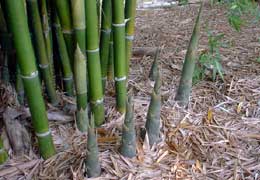
When a patch of bamboo grows new canes, or culms, it does so by feeding those new shoots with food energy produced by all the existing foliage, photosynthesizing in the sun. Being fueled this way allows the new shoots to grow at an explosive rate. The new shoots break through the ground and rocket upward at breakneck pace, typically reaching their full height in just six to eight weeks, sometimes growing a foot or more a day. Each shoot emerges from the ground with as big a diameter as it will ever have, looking like a torpedo breaking through the soil. Then the new canes race upward as a branchless, leafless poles, and only once they reach their full height do they sprout branches and leaves.
Because the growth of the new shoots is fueled by food energy produced by the existing, mature canes, a small, newly planted bamboo needs some time to progressively send up larger and larger culms before it reaches full height and is sending up culms of the maximum size for that species. Each new crop of canes is fed by the foliage of the previous crop, and so the new canes grow larger than those of the previous crop. Paradoxically, this means that for the first few years after planting, the youngest canes in a clump are the largest, and the oldest canes are smallest.
So how long does it take to reach full size? It depends on what size you start out with, and how big that species gets. Chinese Goddess bamboo only grows to eight feet, so a three gallon pot planted in the spring can be sending up full sized canes the year after planting, sometimes even the same year it is planted. Fifty foot Wong Chuk, or Royal Bamboo, when planted from a three gallon pot, might take four or five years to reach full size from planting out a three gallon pot, but only two years after planting a 25-gallon potted plant.
Uses
Bamboo is considered the world’s most useful plant. The structure of bamboo canes, a hollow tube with walls across the tube at each node, provides for both great strength and great flexibility. That structure, combined with the tremendous amount of biomass bamboos produce each year, have enabled bamboos to become utilized for hundreds of tasks.
A partial listing of some of the uses to which bamboo is put includes construction material for buildings, furniture, bridges, boats, musical instruments, kitchen utensils, paper, woven mats & basketry, and the new shoots of some varieties are prized for food. Bamboo houses have survived earthquakes relatively unscathed while other houses around them crumbled.
Taxonomy & distribution
Bamboo is a member of the grass family. It represents the grass family’s way of producing tree-sized plants that can compete with trees in a forest environment. There are over a thousand different species of bamboo in the world, with a tremendous diversity of sizes, growth habits, and environmental preferences. The largest grow to 120 feet tall with twelve inch diameter canes; the smallest are creeping ground covers barely a few inches tall.
Most people associate bamboo with east Asia, and it is true that there is a large center of bamboo species diversity in China and Japan. It’s less well known that there are also bamboos native to Australia, Africa, South America, and a single species that is native to North America. The two biggest biodiversity hot spots for bamboo are China/Japan, and Central/South America, with many hundreds of species native in each of these areas. The Central/South American bamboos are generally either from either lowland tropical areas, in which case they can’t handle much frost, or they are from cool, mountainous regions, in which case they can’t handle hot, humid summers. That pretty much rules out New World bamboos for North Florida gardeners, although in the southern part of the state some of the tropical lowland types do well.
Only the China/Japan region has a climate approximating that of North and Central Florida, with hot, humid summers alternating with winters that frequently produce some hard freezes. Consequently, most of the bamboos grown in this area are native to Asia.
For additional information on planting and growing bamboo, see the pages:
About Bamboo
Bamboo Planting & Care
Bamboo Questions & Answers
Bamboo Cold Hardiness
 Florida Bamboo & Fruit Trees